GamesAI: Revolutionizing AI in Gaming
Discover how gamesAI is revolutionizing the gaming industry, from smart NPCs and adaptive landscapes to dynamic difficulty adjustments, creating immersive, lifelike experiences.
July 20, 2026 · Product News
## GamesAI: AI's Evolving Role in Modern Gaming
Have you ever paused during an intense gaming session and wondered how the enemy seemingly knew exactly where you were hiding? Or how a non-player character (NPC) managed to react so naturally to your dialogue choices? The magic behind these moments isn't magic at all—it is the rapidly evolving field of gamesai.
The implementation of AI in gaming has fundamentally shifted how virtual worlds operate. We are no longer just fighting predictable patterns; we are engaging with dynamic systems capable of learning, adapting, and surprising us. Today, artificial intelligence game development has moved from the periphery of game design right to its beating heart.
In this comprehensive guide, we will explore the intricate workings of game AI. Whether you are a curious player, an aspiring developer, or a seasoned studio veteran, understanding these mechanics will completely change how you view your favorite digital worlds.

## The Evolution of Artificial Intelligence Game Development
Historically, what we called "AI" in video games was simply a series of clever "if-then" statements. A Goomba in Super Mario Bros. walks forward until it hits a pipe, then turns around. While effective for early arcade titles, modern players demand much more from an AI video game.
Today's gaming AI encompasses everything from how enemies flank you in a shooter, to how vast, infinite universes are generated on the fly. As players seek deeper immersion, studios are investing heavily in AI game development to create ecosystems that feel truly alive.
## Core Brains: Decision-Making and Logic
At the center of any intelligent entity in a game is its decision-making framework. How does an NPC know whether to attack, flee, or seek cover? Building effective decision making systems for bots is crucial for player immersion.
### Frameworks of the Digital Mind
When developers sit down to code an NPC's "brain," they have several architectures to choose from.
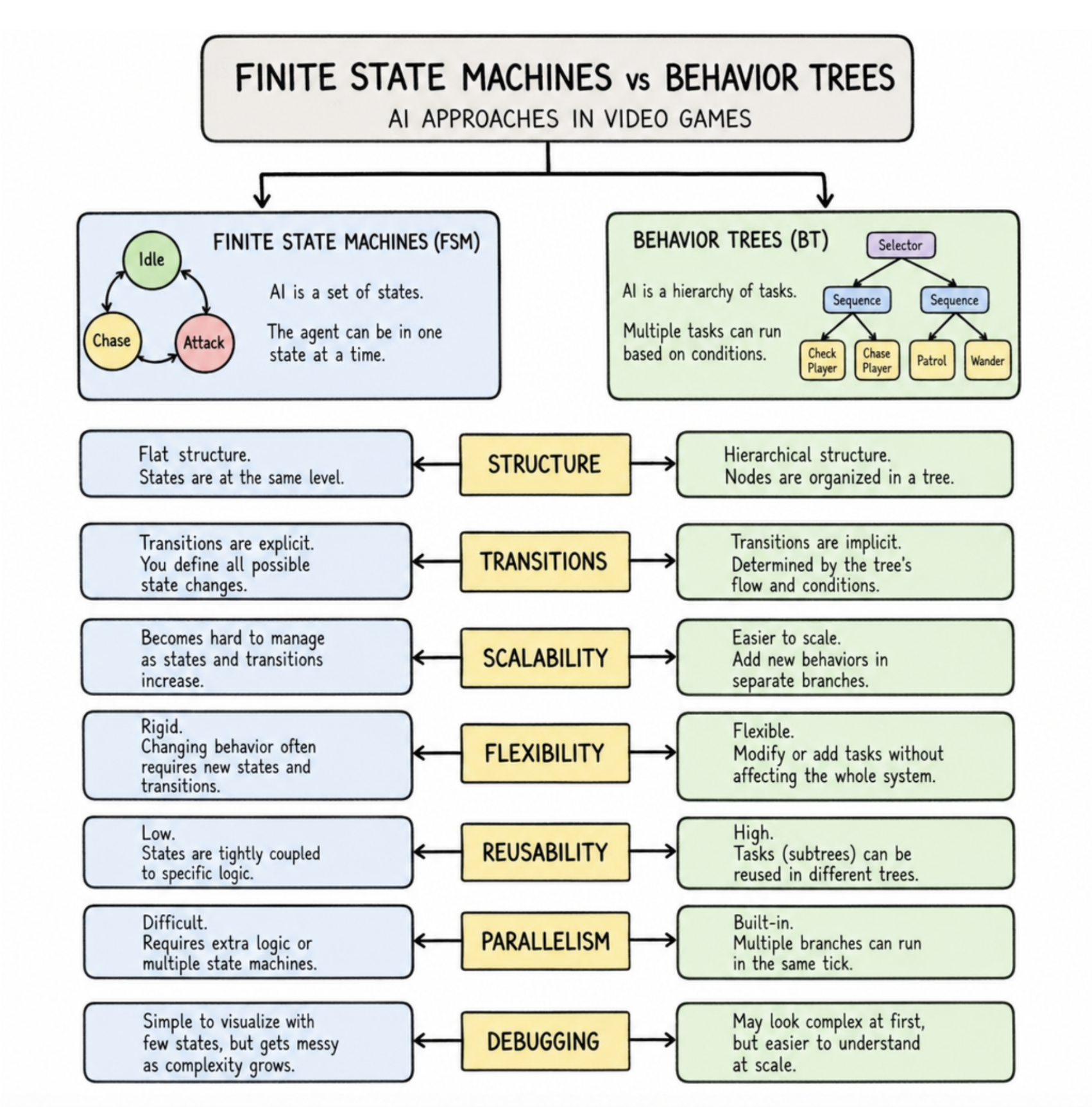
- Finite State Machines (FSMs): This is the oldest and simplest method. An NPC is in a "state" (e.g., Patrolling). If they see the player, the state changes (e.g., Attacking). However, FSMs can become incredibly messy as games grow more complex.
- Hierarchical Task Networks (HTNs): HTNs allow NPCs to think in terms of overall goals broken down into sub-tasks. When looking at finite state machines vs hierarchical task networks, FSMs are best for simple enemies, while HTNs are ideal for strategic squad behavior, allowing NPCs to plan multiple steps ahead.
- Behavior Trees: If you want to know how behavior trees work, picture a flowchart. Starting from a "root," the AI checks conditions down various branches (e.g., "Is player visible?" -> "Do I have ammo?" -> "Shoot"). They are highly modular and have become the industry standard for AI game design, famously popularized by the Halo franchise.
## Advanced Planning and Scoring
For developers aiming for top-tier intelligence, simpler trees might not cut it. If you ever read a modern goal oriented action planning guide (GOAP), you will learn that instead of telling the AI what to do, you give it a goal (e.g., "Eliminate the player") and let it figure out the sequence of actions to achieve it based on its current environment.
Furthermore, studios often use utility systems for complex simulations (like The Sims). In utility based architecture comparisons, developers score every possible action an NPC can take from 0 to 100 based on their current needs. The AI simply executes the action with the highest score, resulting in incredibly organic and unpredictable behavior.
## Navigating the World: Movement and Pathfinding
An intelligent NPC is useless if it spends the entire game walking into a wall. Getting a character from Point A to Point B smoothly is one of the most resource-intensive aspects of AI in games.
### Setting the Stage for Movement
The foundation of modern 3D game movement is the Navigation Mesh, or NavMesh. Think of it as an invisible web of polygons laid over the walkable areas of a game world. Implementing navmesh movement ensures that bots understand exactly where they can step, jump, or climb, ignoring the complex geometry of rocks, trees, and debris that act as obstacles.
### Finding the Best Route
Once the NavMesh is in place, the AI needs to calculate the shortest and safest route. This relies heavily on heuristic search methods for navigation. The most famous of these is the A* (A-Star) algorithm.
A* evaluates the cost of moving to the next node on the NavMesh against the estimated distance to the final target. By prioritizing paths that bring the AI closer to its goal with the least resistance, gamesai ensures enemies don't take bizarre detours to reach you.
- Pro Tip for Developers: When implementing pathfinding, always group your moving units. Calculating A* for a swarm of 50 zombies individually will tank your frame rate. Instead, calculate the path for a "leader" and have the rest use simpler flocking behaviors to follow.
## Crafting Lifelike Characters
We've covered how they think and how they move. Now, how do we make them feel human? Optimizing non-player character intelligence is what elevates an engaging game into an unforgettable masterpiece.

### The Rise of Machine Learning in NPCs
Traditionally, NPCs are hard-coded. But the future points toward reinforcement learning for npc development. By using machine learning, developers can drop an AI into a test environment, reward it for successful actions (like landing a hit), and punish it for failures (like falling off a cliff). Over thousands of iterations, the AI trains itself to be an absolute menace—or a highly competent ally—without the developer manually scripting every behavior.
### Social and Narrative Intelligence
Combat isn't the only focus. Role-playing games thrive on simulating realistic social interaction. We are beginning to see systems where NPCs remember past interactions, hold grudges, or spread rumors to other characters based on the player's actions.
Furthermore, the integration of large language models in quest design is completely revolutionizing narrative. Imagine approaching a digital barkeep and actually speaking into your microphone, with the barkeep generating a unique, context-aware, and fully voiced response on the fly. This level of dynamic dialogue ensures that no two playthroughs are ever exactly the same.
## Building Worlds: Procedural Generation and Art
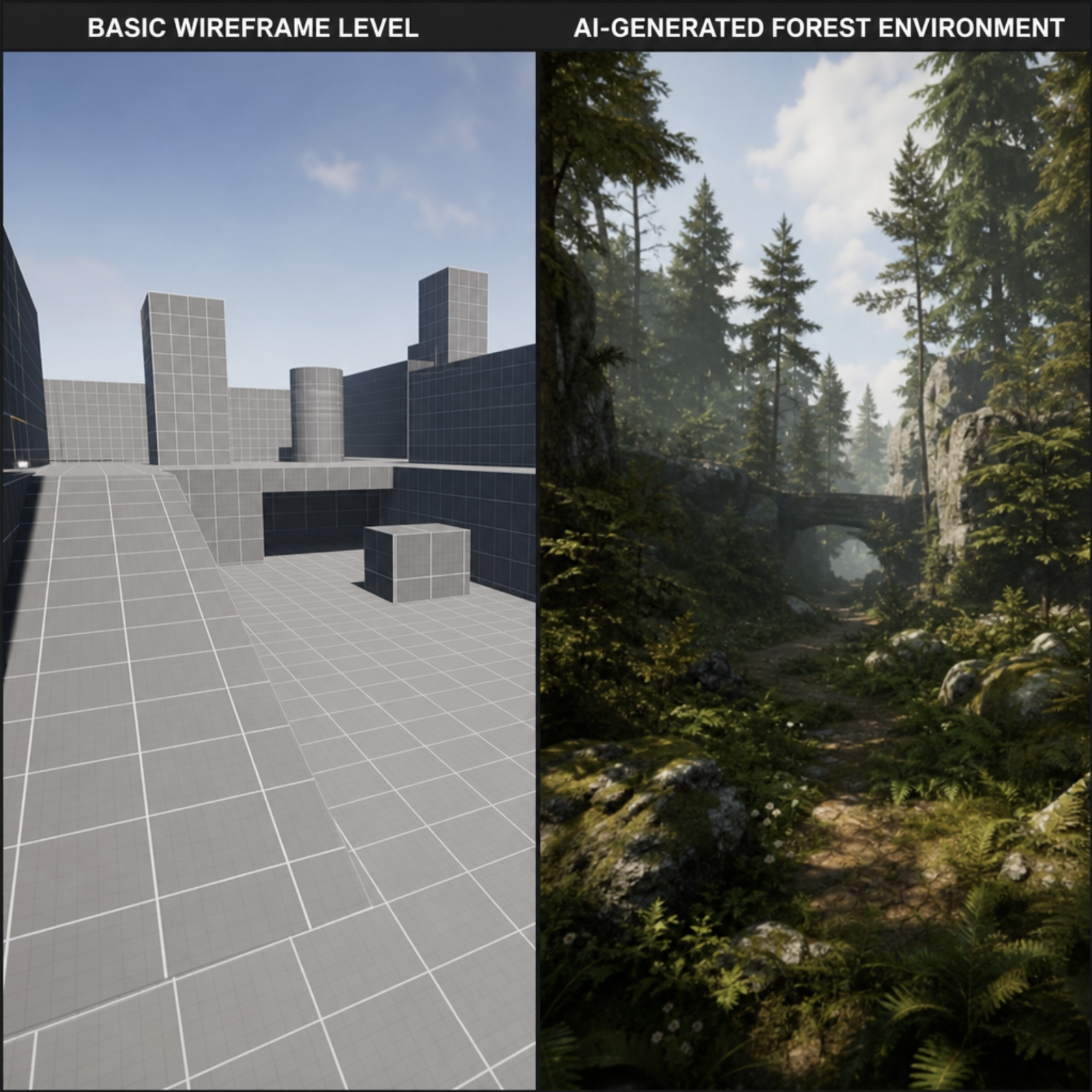
AI gaming isn't limited to character behavior; it is literally building the worlds we play in. Generating massive, highly detailed environments by hand takes thousands of hours. AI accelerates this dramatically.
### Infinite Playgrounds
Through procedural level generation techniques, algorithms can instantly create vast dungeons, sprawling cities, or even entire galaxies (as seen in games like No Man's Sky). By establishing a set of mathematical rules, the game's AI pieces together assets to ensure the generated level is playable, logical, and aesthetically pleasing.
### Visuals and Textures
Behind the scenes, developers are leveraging neural networks for texture synthesis. Instead of an artist spending hours painting a high-resolution stone wall, they can feed a low-resolution image into an AI tool that intelligently upscales it, adds realistic lighting maps, and generates seamless 4K textures in seconds. This allows indie studios to produce AAA-quality visuals on a fraction of the budget.
## Balancing the Game Experience
A game that is too hard is frustrating; a game that is too easy is boring. Hitting the "Goldilocks zone" is notoriously difficult, but game ai provides powerful tools to manage player experience and game balance.
### Adapting on the Fly
To keep players in a state of "flow," developers utilize dynamic difficulty adjustment methods. If the game senses you are dying repeatedly at a specific boss, the AI might subtly decrease the boss's health pool, provide extra health drops, or slightly increase the cooldown on the boss's heavy attacks. Conversely, if you are breezing through a level, the AI Director might spawn an ambush to test your reflexes.
### Testing and Refining
Before a game even ships, developers use game automation. AI bots are programmed to play the game thousands of times at superhuman speeds. They test every corner for collision bugs, check if a level is beatable, and report errors.
For multiplayer titles, developers employ evolutionary algorithms for game balancing. By having AI bots play a fighting game or a strategy game against each other millions of times, the algorithm mutates and evolves strategies to find out if a specific weapon or character is statistically overpowered. This data allows human developers to tweak the numbers before the players ever get their hands on it.
## The Future of GamesAI
We are standing on the precipice of a new era in interactive entertainment. As hardware capabilities expand and cloud computing becomes ubiquitous, the scope of artificial intelligence game development will only widen.
We are moving toward a future where every ai video game features ecosystems that persist and evolve even when you turn the console off. We will see gaming ai that tailors the core narrative to your psychological playstyle, enemies that learn your specific weaknesses, and worlds so deeply simulated that the line between scripted game and virtual reality blurs.
### Summary Takeaways:
- Behavioral Depth: Modern ai in gaming has moved from rigid state machines to fluid behavior trees and GOAP systems, creating highly unpredictable and engaging encounters.
- World Building: Procedural generation and neural networks are allowing smaller teams to build infinitely expansive and beautiful games.
- Player Experience: Through dynamic difficulty and advanced play-testing automation, games are becoming more polished and perfectly tailored to individual skill levels.
Ultimately, ai game development is not about replacing human creativity; it is about providing creators with a vastly expanded toolkit. By understanding and utilizing these complex systems—from navmeshes to large language models—developers can focus on what truly matters: crafting unforgettable, magical experiences. The evolution of gamesai proves that in the virtual world, the smartest player in the room might just be the game itself.