GamesAI: Revolutionizing AI in Gaming and Development
Discover the future of gamesai technology, transforming gaming with adaptive AI, personalized player experiences, and next-gen game development innovations.
July 17, 2026 · Game Development
## Exploring the Future of GamesAI Technology
Imagine stepping into a virtual world that not only reacts to your every move but actually learns from your playstyle. A world where enemies adapt to your strategies, characters hold dynamic conversations with you, and landscapes generate themselves on the fly. This isn't a pitch for a distant sci-fi movie; it is the current reality of gamesai.
The intersection of artificial intelligence and interactive entertainment is transforming the digital landscape. AI in gaming has evolved from simple, predictable patterns into complex, self-learning networks that blur the line between human and machine.
In this article, we will take a deep dive into the technology powering modern game ai, explore how these innovations are actively reshaping ai game development, and uncover what the future holds for developers and players alike.

## The Evolution of AI in Gaming
To understand where we are going, we have to look back at the history of artificial intelligence in video games. In the arcade era, "intelligence" was essentially a mirage. Early developers relied heavily on finite state machines in game development. A finite state machine (FSM) dictates that an entity can only exist in one of a few predefined states—like a Pac-Man ghost choosing to "chase," "scatter," or "flee."
While groundbreaking at the time, these models were ultimately predictable. If a player learned the pattern, they could exploit it.
Today, artificial intelligence game development has shattered those early limitations. We are moving away from rigid rules toward systems that can think, adapt, and generate entirely new scenarios. The shift from basic FSMs to deep learning represents a monumental leap in how interactive digital worlds are engineered.
## Core Technologies Powering the Modern AI Video Game
Modern ai game design leverages a vast toolkit of algorithms and models to create lifelike behaviors and seamless performance in any ai video game. Here are some of the fundamental technologies driving this change.
### Navigating the Virtual World
For an NPC (Non-Player Character) to feel real, it must be able to move intelligently. Implementing pathfinding in game engines is a foundational step in AI game development. Algorithms like A* (A-star) are used to map out the most efficient route from point A to point B, helping characters avoid obstacles and navigate complex 3D environments without getting stuck against walls.
### Decision Making: From Scripts to Learning
If pathfinding is the legs of an NPC, decision-making algorithms are the brain.
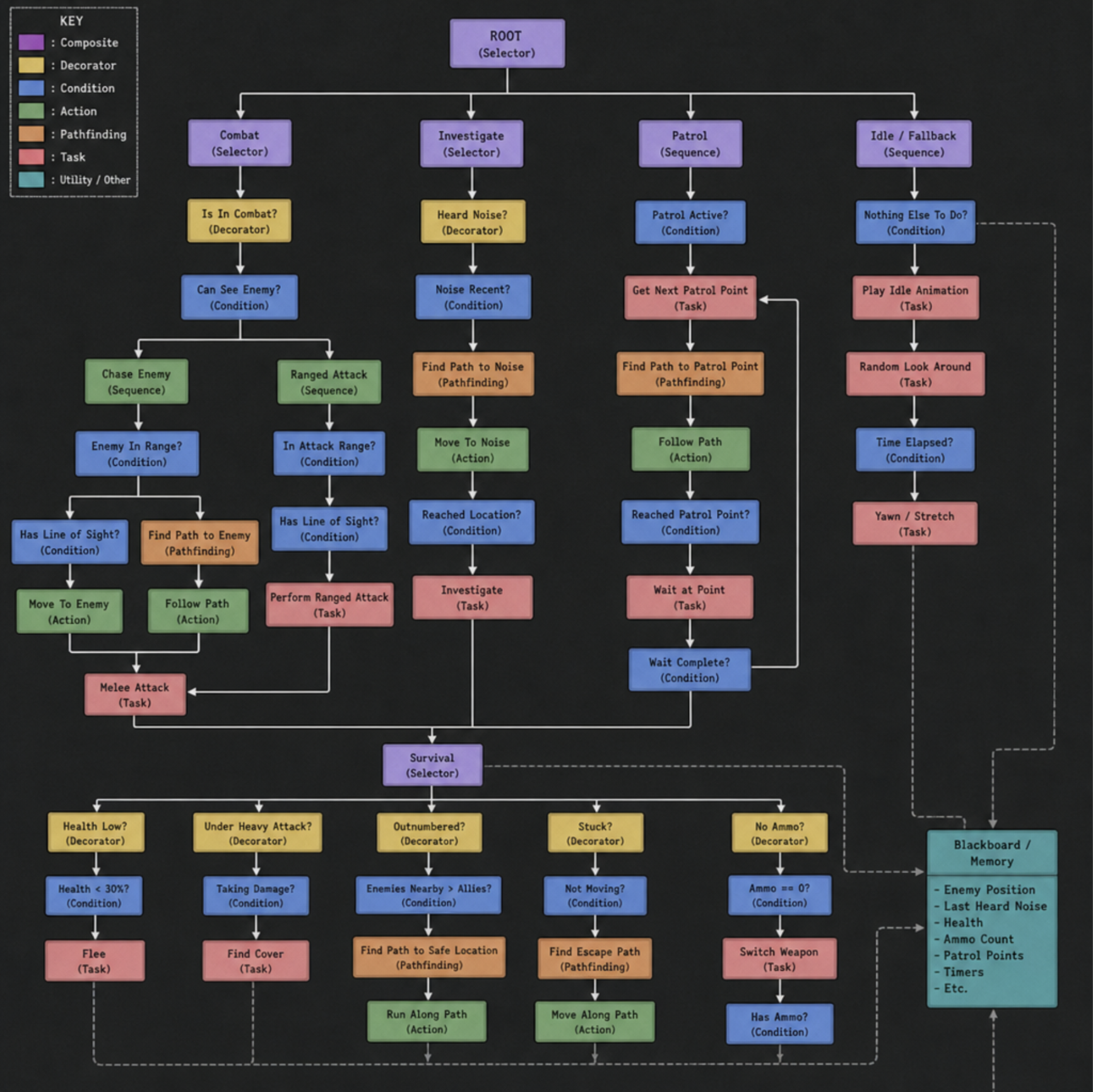
- Non-player character behavior trees: This is a hierarchical model used to control the flow of decision-making. Behavior trees allow developers to create complex, modular, and easily readable logic for NPCs, making their reactions to players feel natural rather than robotic.
- Reinforcement learning vs scripted logic: Traditionally, developers wrote scripted logic (if the player shoots, take cover). Today, reinforcement learning allows AI to learn through trial and error. By rewarding an AI agent for successful actions (like flanking the player) and punishing it for failures, the AI teaches itself the most effective strategies, resulting in vastly more formidable and unpredictable opponents.
## Elevating the Player Experience
A question often asked by both players and developers is: how does machine learning improve gameplay? The answer lies in personalization and immersion. Modern gaming ai isn't just about making enemies harder to beat; it is about crafting an experience tailored to the individual.
### Adapting to Your Skill Level
Nothing kills the joy of a game faster than a brick-wall difficulty spike or, conversely, a lack of challenge. This is where dynamic difficulty adjustment systems (DDA) come into play. By analyzing your performance in real-time—how much health you have left, your accuracy, or how fast you solve a puzzle—the AI scales the game's difficulty on the fly.
However, implementing DDA requires a delicate touch. Developers must focus on balancing NPC intelligence for fair play . If an AI opponent uses machine learning to become too perfect, it feels like fighting an unfair aimbot. The ultimate goal of ai for gamers is to create a "flow state"—keeping the player constantly challenged but never entirely overwhelmed.
### Strategic Brilliance
In strategy games, the computing required to calculate thousands of possible future moves is staggering. To handle this, developers use a technique called Monte Carlo Tree Search in strategy games . This algorithm, famously used by AI like AlphaGo, allows the computer to randomly sample future possible moves to determine the most statistically advantageous play. It results in deeply strategic opponents in games like Civilization or complex digital board games, pushing players to continuously refine their tactics.
## World Building and Narrative: The Generative Era
Perhaps the most visually stunning application of gamesai is how it assists in building the worlds we play in. AI in games—often referred to as ai in games within research circles—is increasingly taking on the role of an artist, a writer, and a level designer.
### Infinite Exploration
Developers are heavily utilizing procedural content generation algorithms to create massive, sprawling universes. Games like No Man's Sky use mathematical algorithms to generate entire planets, flora, and fauna that no human developer ever manually crafted. Modern machine learning pushes this further by ensuring that procedurally generated content makes logical and aesthetic sense, creating biomes that transition naturally.

### Conversations That Feel Alive
Gone are the days of endlessly clicking through repetitive text boxes. We are currently witnessing the integration of generative AI for dialogue and narrative. Large Language Models (LLMs) allow players to use their own microphones to speak to an NPC, and the NPC will respond with historically accurate or context-aware dialogue generated in real time.
This leads directly to the creation of reactive environments and interactive world-building. Imagine a role-playing game where telling an NPC a lie actually affects the global economy of the game's world, or where destroying a bridge causes the AI ecosystem to dynamically build a new settlement elsewhere.
With all this generative power, a common question arises: can AI create entire video games? Currently, the answer is almost, but not quite. While AI can generate code snippets, 3D assets, and dialogue, it lacks the holistic creative vision, emotional intelligence, and nuanced understanding of "fun" that human developers possess. Right now, ai gaming tech acts as a powerful co-pilot, not a solo creator.
## Behind the Scenes: Optimization and Testing
Beyond what the player sees, AI is revolutionizing the unglamorous, heavy-lifting side of game creation.
- Game automation for QA Testing: Quality assurance is notoriously grueling. Developers now use automated AI bots that play through levels thousands of times per minute to find bugs, edge cases, and map glitches before a game ever ships.
- Physics and Performance: Rendering realistic water, cloth, or destruction requires massive computational power. Developers are now reducing computation costs for real-time physics by training neural networks to predict physics outcomes. Instead of calculating every single polygon in a collapsing building, the AI accurately "guesses" the physics simulation, saving incredible amounts of processing power.
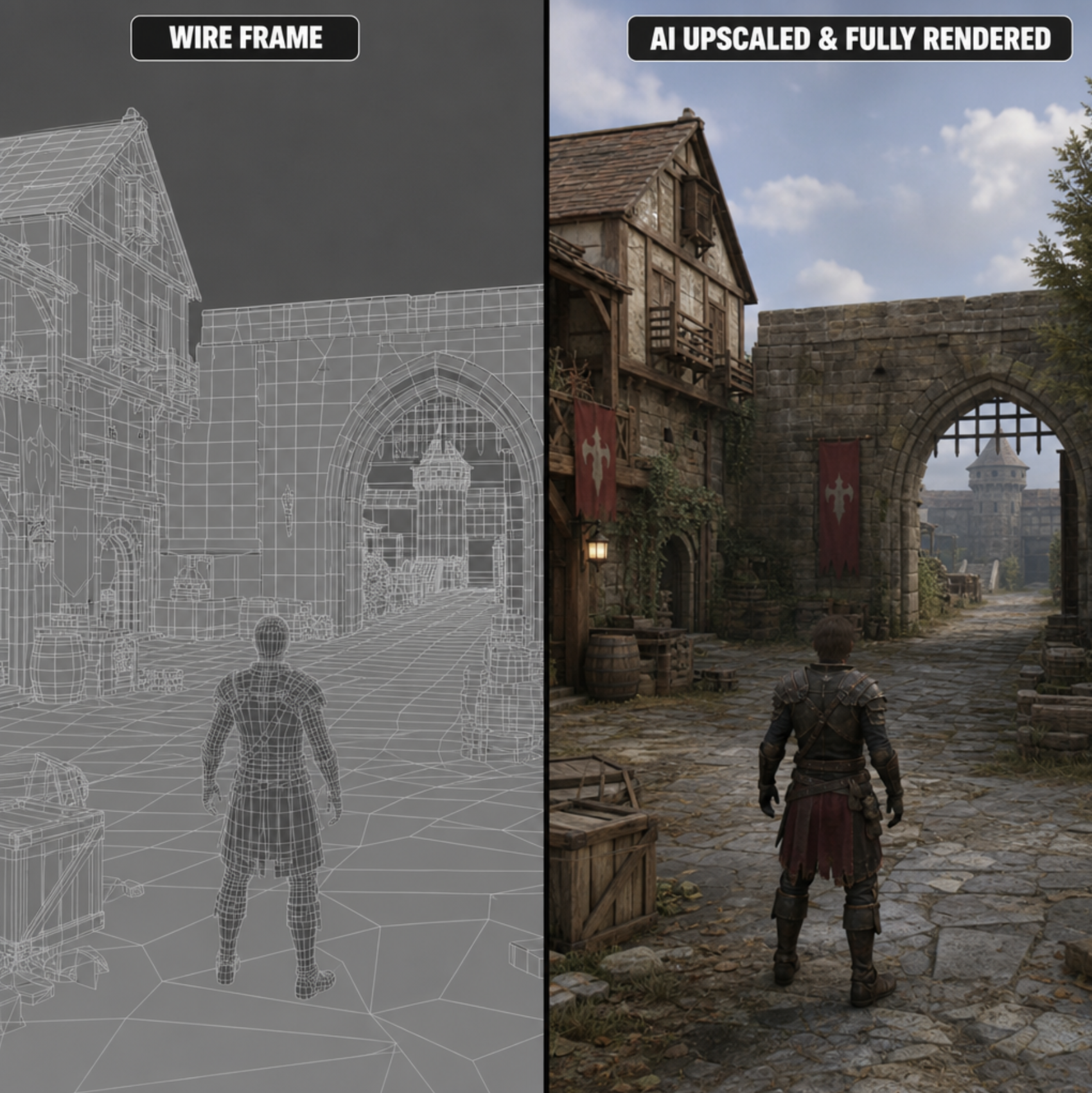
- Visual Enhancements: The industry is currently enhancing player immersion with neural networks. Upscaling technologies (like Nvidia's DLSS) use AI to generate high-resolution frames from low-resolution inputs, allowing games to run at buttery-smooth framerates without sacrificing visual fidelity.
## Actionable Tips for Developers Exploring GamesAI
If you are a developer looking to integrate AI into your next project, keep these practical takeaways in mind:
- Start Small with FSMs and Behavior Trees: Don't jump straight into neural networks if your game doesn't need them. A well-designed behavior tree is often more than enough for excellent enemy AI.
- Focus on the Player's Illusion: Game AI doesn't need to be truly "smart"; it just needs to look smart. Design AI that communicates its intentions (e.g., an enemy yelling "Flank him!") so the player understands the AI's "intelligence."
- Leverage AI Tools for Asset Generation: Use generative AI tools in your pre-production phase to quickly mock up concept art, prototype voice-over lines, or generate base code scripts.
- Prioritize Fair Play: If you experiment with machine learning for enemies, always program a "miss" rate or reaction delay to ensure the player still has a window of opportunity.
## The Takeaway
The future of gamesai is not just about making games look prettier or enemies harder to kill; it is about crafting deeply personalized, infinitely reactive experiences. From the meticulous optimization of physics engines to the limitless potential of procedurally generated galaxies, AI is the new bedrock of interactive entertainment.
Whether you are a developer learning the ropes of artificial intelligence game development or a player eager to explore a next-generation ai video game, one thing is certain: gaming ai is unlocking a level of immersion we once only dreamed of. As we continue to blur the lines between scripted code and cognitive generation, AI gaming stands poised to redefine storytelling, competition, and creativity for decades to come.
Q&A
Question: How has game AI evolved beyond finite state machines?
Short answer: Early games relied on finite state machines (FSMs) with a few predefined states—effective but predictable once players learned the patterns. Modern AI moves past rigid scripts to modular behavior trees for readable, complex decision-making, and to learning-based methods like reinforcement learning that adapt through trial and error. Alongside pathfinding (e.g., A*), today’s systems can think, adapt, and even generate new scenarios, representing a leap from rule-based behavior to self-improving opponents and worlds.
Question: How do dynamic difficulty adjustment (DDA) systems avoid feeling unfair?
Short answer: DDA monitors real-time performance signals—like health, accuracy, and puzzle-solving speed—to scale challenge smoothly. To prevent “aimbot” vibes, developers deliberately cap perfection by adding miss rates or reaction delays and by making AI intentions legible (e.g., enemies calling out tactics). The aim is a sustained flow state: consistently challenging without overwhelming the player.
Question: What is Monte Carlo Tree Search (MCTS), and why is it used in strategy games?
Short answer: MCTS samples and evaluates many possible future move sequences rather than exhaustively calculating them, surfacing statistically strong choices. Famously used by systems like AlphaGo, it enables games such as Civilization to field opponents that plan deeply without prohibitive compute costs. The result is strategically rich, evolving play that pushes players to refine tactics.
Question: Can AI create entire video games on its own?
Short answer: Not yet. AI can generate code snippets, 3D assets, and real-time dialogue, and it supports reactive worlds that respond to player choices. But it lacks holistic creative vision, emotional intelligence, and an intrinsic sense of “fun.” Today, games AI is a powerful co-pilot that accelerates production and enriches experiences, not a full solo creator.
Question: How is AI improving game development behind the scenes?
Short answer: Automated bots stress-test levels at scale for QA, uncovering bugs and edge cases early. Neural networks approximate complex physics, reducing real-time computation while preserving believable outcomes. And AI upscalers like DLSS boost frame rates by reconstructing high-res frames from lower-res inputs—delivering smoother performance without sacrificing visual fidelity.